

Deck Mounting vs. Rafter Attachment: Eliminating Rafter Misses with UltraFoot

When installing residential rooftop solar, attaching racking to structural rafters has long been the standard approach. However, finding rafters beneath composition shingles is rarely a seamless process. Hunting for structural framing leads to exploratory drilling, missed pilot holes, and extra time spent on the roof.
As solar technology evolves, deck mounting has emerged as a reliable alternative. Understanding the trade-offs between deck mounting and rafter attachments—and how purpose-built hardware bridges the gap—helps installation crews work faster while keeping roofs watertight.
The Traditional Approach: Rafter Attachment Challenges
Attaching directly to rafters provides a high structural load capacity per attachment point. However, locate-and-drill rafter attachments present distinct operational challenges on the roof:
- Hunting for Framing: Measuring, tapping, and locating rafter centers through underlayment and shingles takes significant time.
- Exploratory Drilling & Missed Pilot Holes: When an installer misses a rafter, that exploratory hole must be properly sealed. Unsealed or improperly patched missed pilot holes remain a primary cause of water intrusion callbacks.
- Layout Constraints: Array design is strictly dictated by rafter spacing (typically 16'' or 24'' on center), limiting flexibility near roof edges, valleys, or obstructions.
The Deck Mounting Alternative
Deck mounting attaches hardware directly to the roof sheathing (OSB or plywood decking) rather than the underlying rafter framing.
The Advantages
- Zero Rafter Hunting: Installers can place mounts anywhere on the roof plane, simplifying array layout and saving layout time.
- Elimination of Missed Pilot Holes: Because fasteners engage the deck directly, exploratory drilling and missed pilot holes are completely eliminated.
- Layout Flexibility: Crews can place attachments exactly where needed relative to module corners and rail spans.
The Traditional Trade-Off
Historically, deck mounting required a high fastener count—often 4 to 6 screws per mount—to achieve necessary uplift ratings. More screws mean more roof penetrations to seal per attachment point.
Bridging the Gap: The UltraFoot Anchor Solution
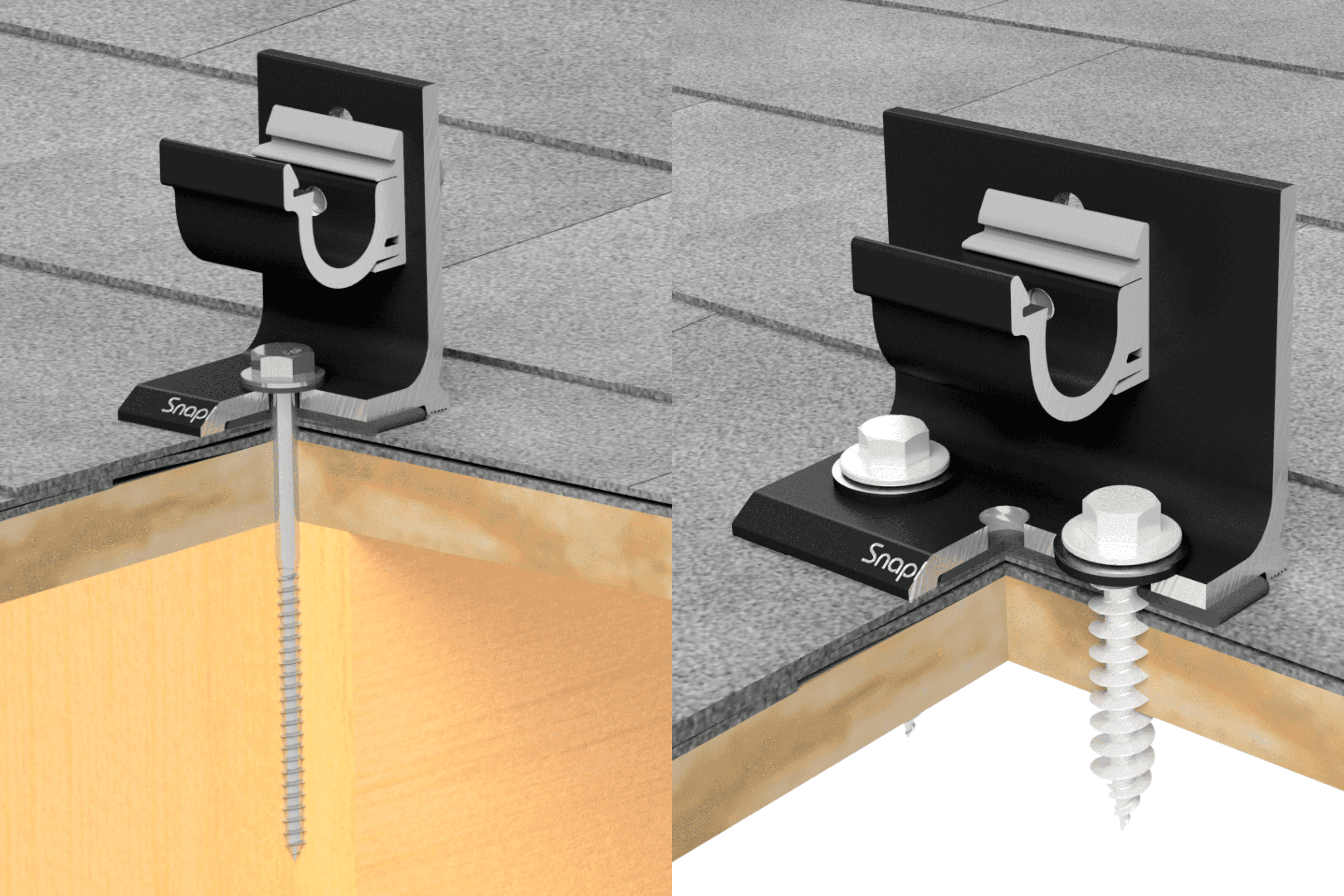
To solve the high fastener count of traditional deck attachments, SnapNrack developed the UltraFoot Anchor.
Designed specifically for deck mounting applications, the UltraFoot Anchor minimizes penetrations while maximizing structural hold:
- Only 2 Screws Required: Unlike traditional deck mounts requiring 4–6 fasteners, the UltraFoot Anchor secures to the roof deck using just two mounting wood screws.
- 600% Better Torque-Out Value: Despite using fewer fasteners, the engineered thread engagement delivers a 600% better torque-out value compared to standard wood deck screws.
- SpeedSeal™+ Watertight Barrier: The UltraFoot Anchor comes pre-assembled with a 0.2" butyl pad underneath. Driving the mounting screws compresses the butyl directly into the penetration holes, creating an instant, permanent watertight seal without messy sealant tubes.
Choosing the Right Method for Your Crew
Both mounting strategies have their place in residential solar:
| Feature | Rafter Attachment | Traditional Deck Mount | UltraFoot Anchor |
|---|---|---|---|
| Primary Anchor Point | Roof Rafter / Truss | Roof Decking (Plywood/OSB) | Roof Decking (Plywood/OSB) |
| Fastener Count per Mount | 1 Lag Screw | 4–6 Wood Screws | 2 Wood Screws |
| Risk of Missed Pilot Holes | Moderate to High | None | None |
| Uplift & Torque-Out Hold | High (Rafter-dependent) | Standard Deck Hold | 600% Higher Torque-Out vs. Standard Deck Screws |
| Waterproofing Technology | Flashing / SpeedSeal™ | Sealant / Butyl Pads | Integrated SpeedSeal™+ Butyl Pad |
Switching to deck mounting allows solar contractors to streamline job-site workflows, eliminate missed pilot holes, and gain array layout flexibility. By choosing engineered solutions like the UltraFoot Anchor, installation teams get the speed of deck mounting with fewer roof penetrations and superior holding strength.